The Jazz Repertory Company Blog

The Jazz Repertory Company Blog

Thursday, 31 August 2017

15 Fascinating Facts About The Musicians Featured In Jazz At Carnegie Hall

Countdown #15:  Duke Ellington's first piano teacher was called Mrs Clinkscales.  In 1944 at Carnegie Hall Duke performed his arrangement of Frankie and Johnny, a number made to showcase his pianistic virtuosity and a testament to the venerable Mrs Clinkscales.

Countdown #14: For 100 year old punk jazz, look no further than James Reese Europe's 'That Moanin' Trombone.' The "Martin Luther King of music" (Eubie Blake), Europe was the leading figure on the African-American music scene of New York City in the 1910s. 

Countdown #13: In 1938 Benny Goodman appeared at Carnegie Hall with one of the first public concerts to feature a racially integrated group.  The live recording of this historic concert is one of the best-selling jazz albums of all time and features the brightest jazz luminaries of the day including Count Basie, Lionel Hampton, Gene Krupa, Buck Clayton, Johnny Hodges and Lester Young.  

Countdown #12: Dizzy Gillespie was the first musician to bring Latin American rhythms to Jazz . (He also ran for the U.S. Presidency in 1964, promising to make Miles Davis head of the CIA). We feature his famous Manteca in our concert "Jazz At Carnegie Hall".


Countdown #11: In 1912, James Reese Europe made history when his Clef Club Orchestra became the first band to play jazz at Carnegie Hall. It is difficult to overstate the importance of that event in the history of jazz in the United States — it was 12 years before the Paul Whiteman and George Gershwin concert at Aeolian Hall, and 26 years before the famous Benny Goodman concert.

Countdown #10: Billie Holiday made her first Carnegie Hall appearance as a headliner in 1948 - just days after being released from prison on a drug charge. It was her first public performance in nearly a year. The high point was her rendition of “Strange Fruit” in the second half with the hall in complete darkness and a single spotlight etching her face.

Countdown #9:  Duke Ellington’s  "Black, Brown and Beige"  premiered at Carnegie Hall in 1943 (it was panned by the critics).  Duke’s composition  was the first extended jazz piece of symphonic dimensions lasting for 45 minutes.   It’s most famous section "Come Sunday" will be performed on 23rd September at Cadogan Hall in our "Jazz At Carnegie Hall" Concert.

Countdown #8: James Reese Europe's "Society Orchestra" became nationally famous in 1912 accompanying theatre headliner dancers Vernon and Irene Castle. The Castles helped "America learn to dance from the waist down," when they introduced the Castle Walk and Foxtrot. 


Countdown #7: Dizzy Gillespie played a trumpet with the bell turned upwards at a 45-degree angle. The story goes that in 1953 someone fell on his trumpet stand, causing the bell back to bend. Gillespie liked the sound and since then had trumpets specifically built the same way. 

Countdown #6: Tony Bennett began his career as a singing waiter in Italian restaurants around Queens aged 13 years.  He has appeared at Carnegie Hall more than twenty times and at 91 is still going strong. 

Countdown #5: In 1918 James Reese Europe led the official band of the African-American Hellfighters regiment. He was the first black American soldier in WW1 to face the enemy in combat when he joined a French unit on a night patrol. This is in stark contrast to the jazz bandleaders of WW2 who were all kept well away from the frontline. 


Countdown #4: Billie Holiday: "Mom and Pop were just a couple of kids when they got married. He was eighteen, she was sixteen and I was three."


Countdown #3: 
James Reese Europe, the first man to bring jazz to Carnegie Hall and the first African American to be granted a public funeral in the city of New York. Having survived the battlefields of WW1 he was murdered backstage by his drummer in 1919. 

Countdown #2: During prohibition from 1920 to 1933, Carnegie Hall hosted a hidden basement speakeasy. It could only be accessed when the patron inserted a key from the outside, and the inside doorman inserted a key from the other and they turned them at the same time. Joan Crawford made her dancing debut within this little club. The space now houses one of Carnegie Hall’s large air conditioning units.

Countdown #1: In 1939 Benny Goodman and Glenn Miller appeared on the same bill at Carnegie Hall. In the first set Benny Goodman stole Millers current hit 'Sunrise Serenade', leaving Miller fuming in his dressing room. In the second half Miller not only repeated this tune but also One O'Clock Jump which Goodman also played in act 1. 

The Jazz Repertory Company returns to Cadogan Hall on the 23rd September for the brand new show Jazz At Carnegie Hall.


Wednesday, 21 June 2017

Hep Cats, Jive Cats, Cool Cats and A Catalogue Of Mogs

During a quiet spell in the office when no-one out there seemed inclined to enquire after one of our smashing bands to help them celebrate their birthday, wedding or death I thought I’d look at one of our YouTube videos to reassure myself that what we had to offer was really rather good.

First thing I alighted on was the Pete Long Orchestra playing Shiny Stockings and I noted that 363 people had watched it. Now that video had been up for around 6 months so it’s not a great total. 

The Pete Long Orchestra plays Shinny Stockings
The Jazz Repertory Company's 1956: A Jazz Jubilee

Like a chump, I had to go and make myself feel even worse by arbitrarily choosing a cat video and seeing how The Jazz Repertory Company compared.  First one I saw was “The Funny Cats Compilation 2016.”  This had been up around the same time as Shiny Stockings but it had racked up 2,381,238 views.

The Funniest Cats Of 2016 Compilation

Having seen all seven series of Mad Men and having replaced my fantasy of being Buddy Rich with my very recent fantasy of being Don Draper I sprang into action immediately.  I put on my Brooks Brothers suit, drank a bottle of scotch, made a (failed) pass at the woman heading up my accounts department (my wife) – called a meeting of all my staff (my wife) and proposed that we immediately instigate an advertising campaign for The Jazz Repertory Company using cats or, possibly with our somewhat limited budget, a cat. 

With the budget being set at six cans of Whiskers, a Sainsbury’s pack of king prawns and £5 worth of assorted cat toys I was ready to go.   By a remarkable coincidence I had programmed into our September Cadogan Hall concert  Jazz at Carnegie Hall  Zez Confrey’s  1920’s piano novelty Kitten on the Keys – this would be a perfect opportunity for a cat to be brought on stage and do something cute like……  oh it doesn’t matter the bloody cat would refuse to do it anyway.

Zez Confrey's Kitten On The Keys

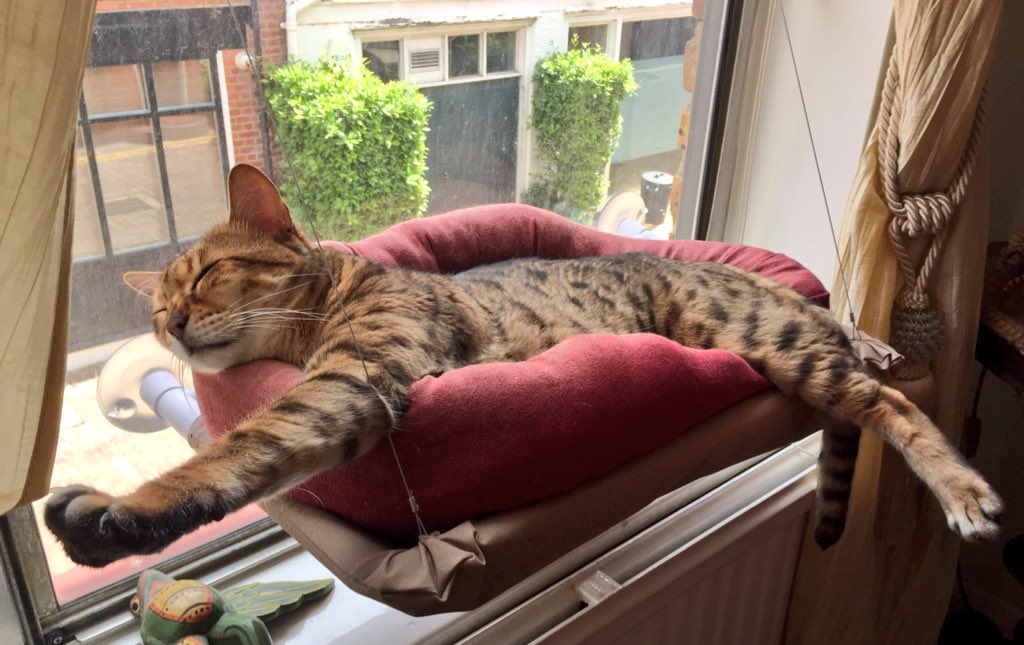
We had found a cat – he was called Archie.  Archie had opened a twitter account a couple of months back and had already overtaken me with the number of followers he had – this was clearly a cat with charisma.  I called Cadogan Hall and told them I intended to have Archie come on stage during Kitten on the Keys and refuse to do something cute.  I assured them that Archie’s equally cute owner would bring him on with a lead and the whole thing would be an amusing throw back to 1974 and a cross between The Generation Game and Animal Magic.

However it was now 2017 and Cadogan Hall’s answer was that due to the following, Archie’s presence was impossible.
  1. Health and Safety
  2. Countless EU regulations (come on Teresa, pull your finger out girl!!!).
  3. Their insurance policy and (confusing cats' bathroom habits with dogs) the possibility that musicians could slide on Archie’s widdle then plunge into the front row and squash a handful of OAPs thus instigating a multi-million pound lawsuit (Archie Cattus Domesticus vs Regina).
Not put off by this set back we have continued with our experiments playing various styles of jazz to Archie to see where his tastes lie and what may cause him to react in a way that may lead to 9 million views on YouTube.

Archie - Photo by Giles Bracher

The test results thus far are as follows.

Archie’s response:  Nothing

Archie’s response:   Nothing

Archie’s response:  Yawned and licked his genitalia

Archie’s Response:  Nothing

Glenn Miller's In The Mood
The Jazz Repertory Company

I think Archie so far has been taking the art of cool to ridiculous extremes – I keep showing him the seating plan of Cadogan Hall with its sea of unpurchased seats and I explain just how crucial his contribution is.  Archie’s response:  Nothing.

We will be publishing an update on progress in August – for the time being here is a picture of Archie enjoying Diana Krall’s latest CD. 

Archie

Wednesday, 3 May 2017

Drummer Man - Richard Pite is Gene Krupa in "Flawless" Centenary Concert

Review: Gene Krupa Centenary Tribute/ Cadogan Hall


Richard Pite as Gene Krupa

There wasn't really any need for kitchen performance anxiety tonight. One of the cast-iron certainties in British jazz is that a band directed by Pete Long will cook.  
Gene Krupa

This remarkable phenomenon generally known among musicians as Plong, this hyper-active multi-reedsman, in whom Croydon, I am told, is mysteriously inflected with a possible hint of Malta, has led successful Ellington projects, riotously good Dizzy Gillespie projects, and much else besides. Long knows his craft, he delivers meticulously edited parts onto the stands. He bandleads and MC's for Britain.
Richard Pite guest expert on Gene Krupa for BBC Radio

Thus there were many great moments tonight, when not only the sound, but also the visuals were totally convincing. Pete Long was shuffling around in a burgundy tail-suit, on clarinet, in charge. Enrico Tomasso was alongside him, squeezing blistering high notes out of the trumpet, his whole face rapidly becoming a perfect colour-match for Long's suit. Joan Viskant was finding the vocal colours of her - and also Krupa's - home town of Chicago circa 1940.Period-style specialist Martin Wheatley on guitar was being subtly and predictably flawless. In the background the microphone stands suspended over drummer Richard Pite's head were dancing in time. And the audience of several hundred at Cadogan Hall were showing how much they were enjoying it by whistling, whooping and cheering at the end of just about every number. 
Jazz Repertory Co at Cadogan Hall: Gene Krupa Centenary Concert

Tuesday, 25 April 2017

"TRULY SHOW-STOPPING" - The Golden Age Of British Big Bands Reviewed

REVIEW: Jazz Repertory Co. - The Golden Age of British Big Bands at Cadogan Hall

The Golden Age Big Band
Photo credit: Paul Wood

Jazz Repertory Co. - The Golden Age of British Big Bands 
(Cadogan Hall, 23 April 2017. Review by Peter Vacher)
 

Deep in the Leytonstone think-tank where the Jazz Repertory Company draw up their plans, great minds work tirelessly to devise new enterprises and projects, or as we know them, to create themed concerts designed to tickle the fancy of the Cadogan Hall’s happy band of faithful followers. 

The skills and ingenuity of team leaders Richard Pite and Pete Long are crucial to these endeavours, each concert like a new book whose pages have yet to be turned. That these two musical magpies continue to come up with cleverly devised, thoughtful programmes may well be one of the small wonders of the age. And that of course brings us to their latest outpouring devoted to British big bands which debuted last Sunday. 

Pete Long
Photo credit: Paul Wood

In a concert that lived up to the cliché of a game of two halves, the first took the largely populist route with the accent on vocal recollections, with everything from a George Formby favourite warbled by Spats Langham with ukulele accompaniment to a pair of duet s between the sweet-voiced Janice Day [who also had a neat solo turn on That Lovely Weekend] and Langham. All nicely done; even if the outstanding Pete Long orchestra was confined to playing second fiddle. No such caveat for Alex Garnett who took on the tenor role in the Coleman Hawkins/Jack Hylton version of Melancholy Baby with his usual creative tenacity, the band writing cleverly devised. Along the way, Fred Elizalde’s spirited 1928 chart for Crazy Rhythm had aged beautifully, with Jay Craig emulating Adrian Rollini on bass saxophone, followed by a rousing Harry Roy piece and then the climactic Bakerloo Non-Stop, from the days of Ted Heath, all brass and belligerence, with lead trumpeter Nathan Bray triumphant in the spotlight. 
Tom Spats Langham, I Told My Baby With My Ukulele
The Golden Age Of British Big Bands

With Heath’s Hot Toddy’/’Swinging Shepherd Blues post-interval again exploring the popular, Stan Tracey’s Afro Charlie Meets The White Rabbit then offered a bracing-eye’s view of the jazz uplands with Garnett heard at length and in supreme form, every nuance explored, each short phrase cooked to perfection. Tracey’s unlikely collaboration with Acker Bilk came good with Long’s mellifluous clarinet rendering of Stranger on the Shore before we again reverted to the hit parade with trombonist Chris Dean’s pair of truly show-stopping vocals recalling the heyday of Matt Monro. Jazz-free but superbly done. Back into the premiership with two pieces culled from the Tubby Hayes
big band pad; Parisian Thoroughfare giving trumpeter Freddie Gavita his chance to unwind a long, looping improvisation that had boppish élan as its trademark, before trumpeter Mark Armstrong [NYJO’s Musical Director] combined with Garnett on Suddenly Last Tuesday to provide the kind of heartening evidence that all was well on the jazz front. Brilliant chart, superbly executed, tremendous soloists.

Alec Dankworth
Photo credit: Paul Wood
Good, too to celebrate John Dankworth, especially since son Alec Dankworth was on bass, with the very catchy African Waltz and the cleverly-constructed Tomorrow’s World theme, this before a roaring tribute to NYJO itself with Bill Charleson’s demanding arrangement of My Old Man this allowing trombonist Callum Au to do some solo muscle flexing. Fast and furious, for sure.

The Golden Age Big Band
Photo credit: Paul Wood

THE BAND:


Pete Long [MD, cl, as]; Janice Day [voc]; Thomas Langham [voc/g]; Martin Litton [p]
Freddie Gavita, Nathan Bray, James Davison, Mark Armstrong [t, fgh];
Chris Dean [tb/voc]; Andy Flaxman, Callum Au [tb]; Mark Frost [b-tb];
Bob Sydor [ts, cl, f]; Alex Garnett [ts, cl, f]; Colin Skinner [as, cl, f, picc, sop]; Simon Marsh [as, cl, f]; Jay Craig [bs, cl, b-cl, bass-sax]
Alec Dankworth [b]; Richard Pite [d].
The Jazz Repertory Company
Something To Make A Noise About

Thursday, 20 April 2017

“You know Glenn Miller, he did the music for World War Two” - The Golden Age Of British Big Bands


13 Countdowns To Our St George's Day Cadogan Hall Concert, 
The Golden Age Of British Big Bands, 23rd April, 7pm 2017.

Countdown #13: One night when the Ted Heath Band was sharing the bill with another big band, Johnny Hawkesworth was coming off stage carrying his bass.  As he passed the other bass player going on he leant over and said “watch the bowler at your end”.

Ted Heath: Swingin’ Shepherd Blues featured in The Golden Age of British Big Bands.

Countdown #12: A bandleader I used to work for always announced any Glenn Miller number by saying “You know Glenn Miller, he did the music for World War Two”.

Countdown #11: “Do you know the difference between a ukulele and a banjo?  A banjo takes longer to burn.” George Formby.
George Formby: I Told My Baby With My Ukulele featured in The Golden Age of British Big Bands

Countdown #10: Tom Langham sings George Formby's 1932 hit "I Told My Baby With My Ukulele."


Countdown #9: “I visited an Italian restaurant in New York which was run by the Mafia.  The house speciality was broken leg of lamb”  Ronnie Scott
Tubby Hayes Big Band:  Suddenly Last Tuesday featured in The GoldenAge of British Big Bands

Countdown #8: Clarinet players sometimes hold their reed against a coin and burn the top edge away to harden them.  A certain clarinet player turned to the pianist Bert Murray and asked if he’d got a 10p piece to burn his reed and Bert looked up saying  ‘Here’s a quid, burn the whole bloody clarinet”

Countdown #7: A well know band leader confessed to being paranoiac, IanChristie told him “No, you’ve got it wrong.  Paranoia is when you think people don’t like you.”
Harry Roy:  Milenberg Joys featured in The Golden Age of British BigBands.

Countdown #6: We stayed in a hotel the other night.  Talk about mean, he turned the gas off while she turned the bacon over and when we went in to breakfast we found the tomato ketchup on an optic”  Acker Bilk.

Countdown #5: “I’d now like to hand you back to the band.  Each man is a soloist in his own right – it’s only when they play together that they get into trouble”  Ronnie Scott
Tubby Hayes Big Band: Parisian Thoroughfare featured in The GoldenAge of British Big Bands

Countdown #4: Kenny Clare always played marvellous drum solos with my band.  I remember playing a firemen’s dance in Hull – a fireman came up to me saying Kenny’s drumming was absolutely fantastic,” but mind you, we’ve got a bloke who plays in a pub round the corner who’s even better” – John Dankworth

Countdown #3: The great drummer Phil Seaman was playing drums in the pit orchestra for West Side Story.  One night he nodded off to sleep during a quiet spot and fell off his stool and crashed into his big gong.  With great presence of mind, he stood up and announced “Dinner is Served” - Ronnie Scott
Tubby Hayes Big Band: Suddenly Last Tuesday featured in The Golden Age of British Big Bands.

Countdown #2: When the Stones drummer Charlie Watts appeared in the club with his enormous big band    Apart from Charlie there were two other drummers.  I remember hearing the band rehearse and at the end of one opus Charlie enquired if the tempo was OK.  To which a voice from the sax section said “Great.  I liked all three tempos”  Ronnie Scott

Countdown 1# Talking about putting new tunes on top of old chords.  I have just acquired an album of the National Youth Jazz Orchestra on which some bright young thing has taken the chords of “Thou Swell” and turned it into a bebop extravaganza called “Gynaecology”  Digby Fairweather
National Youth Jazz OrchestraMy Old Man Said Follow The Van featured in 


Sunday, 2 April 2017

Bravo the British big band scene old and new: who said the golden age was over...Concert Preview

PREVIEW: The Golden Age of the British Big Bands, (Cadogan Hall, April 23rd)


Jack Hylton, Ted Heath, Tubby Hayes, John Dankworth...
All represented in The Golden Age of the British Big Bands at Cadogan Hall

The Jazz Repertory Company has a new show, "The Golden Age of the British Big Bands." The premiere is on St George's Day, April 23rd, at Cadogan Hall. The concert will present a programme selected from  a large repertoire and long tradition; the earliest arrangement is from 1928, the last from 1980. Peter Vacher explains this great heritage and the background to the concert. He writes: 

While we may accept, reluctantly perhaps, that the Golden Age of the big bands, British or American, is a thing of the past, it’s clear that the desire to play in a collective situation continues to exert its pull on jazz musicians, here and elsewhere. Consider the number of rehearsal big bands that exist up and down the United Kingdom, as well as the professional touring orchestras that re-create, say, the repertoire of Glenn Miller. The challenge of executing complex arrangements in an exciting fashion must be a source of great satisfaction to those who meet it: witness the many fine players who have been recruited by Richard Pite and Pete Long to perform for the Jazz Repertory Company’s concert series and the excellence of their achievements. 


On stage at Cadogan Hall for 
The Golden Age Of British Big Bands
 
This time, the challenge is even more considerable – how to replicate and re-energise music as varied as that performed by the Spanish-Filipino pianist Fred Elizalde and his band of US expatriates in London in 1928 and then by the concert’s end, to recall the smart-sounding innovations of John Dankworth in the 1960s? In thinking back to the Elizalde era, it’s perhaps timely given our impending exit from the European community to reflect on the welcome contributions of these overseas musicians, like the Americans, multi-instrumentalist Adrian Rollini and trumpeter Chelsea Quealey who settled here and enlivened Elizalde’s recordings and engagements. 

And then again it’s instructive to recall the periods spent in Britain by a number of the commanding figures in jazz when their presence helped to make between-the-wars London such a hot-bed of musical adventure. The great US tenor-saxophonist Coleman Hawkins appeared and toured with Jack Hylton’s band in the 1930s and it’s their version of ‘Melancholy Baby’ that is included in the Cadogan Hall programme. Benny Carter, too, was in town, arranging for the Henry Hall radio orchestra and pianist Fats Waller toured our variety theatres. How sad that the British Musicians Union’s desire to protect UK jobs should then have led them to ban American jazz musicians from working here for the next 20 years or so, thus depriving local musicians and British audiences of the chance to hear the world’s greatest players in their prime. 

On stage at Cadogan Hall for 
The Golden Age Of British Big Bands
Bands like those led by Hylton, Ray Noble and Ambrose had already earned their popularity by appearing at top hotels and night-clubs where the glitterati of the day would dance the night away, never giving a fig for any putative jazz talent that might or might not adorn their bandstands. They just wanted a good time and these bandleaders saw to it they had just that, adding to their fame with radio-hook-ups and many recordings. These leaders were the ‘celebrities’ of their day, courted and feted by the elite. Another such band and an unusual one at that was led by Guyana-born dancer Ken ‘Snakehips’ Johnson and consisted of the very best West Indian players then resident in London. Their break- through engagement was at the Café de Paris but sadly their triumph was short-lived for Johnson was killed outright when a German bomb hit the Café mid-performance on 8 March 1941. It’s their version of ‘It Was a Lover And His Lass’ that adorns the programme with Spats Langham recalling the mellifluous tones of vocalist Al Bowlly, another whose career was so sadly truncated when he too was killed in a WW2 air-raid just two months after Johnson. Fittingly for a St George’s Day concert the words are by our national playwright, William Shakespeare. 

Easily the most prominent big band of the 1940s and 1950s was that led by former Ambrose trombonist Ted Heath, a canny operator who knew how to keep the pop charts ticking over with popular numbers featuring his star singers Lita Roza and Dickie Valentine, while allowing his superb sidemen their chances to shine with numbers like Bakerloo Non Stop. Like Heath, Dankworth had started his orchestra as a touring ensemble taking residencies and playing one-nighters up and down the country. Gradually, though, as touring opportunities began to dwindle and the demand for social dancing began to wane, Dankworth transferred his exceptional compositional skills to the creation of evocative TV signature tunes and masterly movie soundtracks, his band only re- convened for the occasional tour or one-off engagement. Other bands were re-imagined as ‘tribute’ ensembles and more specifically, as in the case of the Tubby Hayes and Stan Tracey bands, whose music will also be heard at Cadogan Hall, as vehicles for the special jazz arrangements produced by band members. No dance hall gigs for them; here it was the bravura of the compositions and the creativity of the soloists that carried the day. 
On stage at Cadogan Hall for 
The Golden Age Of British Big Bands
 
Our big band journey takes us from the ‘hot’ dance bands of the 1920s catering to the ‘beautiful people’ of the day through to the touring ballroom favourites of the 1930s and beyond and alights finally in to the specialist world of these ‘jazz’ orchestras. From Crazy Rhythm to Tomorrow’s World, you could say, and this all accomplished by Long’s scintillating team and their attendant vocalists, Spats Langham, Chris Dean and Janice Day. And reverting to our opening paragraph, Long’s men will conclude the concert by paying a heart-felt tribute to the National Youth Jazz Orchestra as they recreate NYJO’s 1980s arrangement of Marie Lloyd’s timeless My Old Man Said Follow The Van. This selection underlines the extraordinary contribution made by NYJ0 in their 50-year existence to keeping the British big band tradition alive and well. NYJO alumni have rightly taken their place on the world big band stage and helped to foster and renew the big band tradition. So, bravo the British big band scene old and new: who said the golden age was over… it’s just been resting, that’s all! (pp)
The Jazz Repertory Company
Something worth making a noise about.